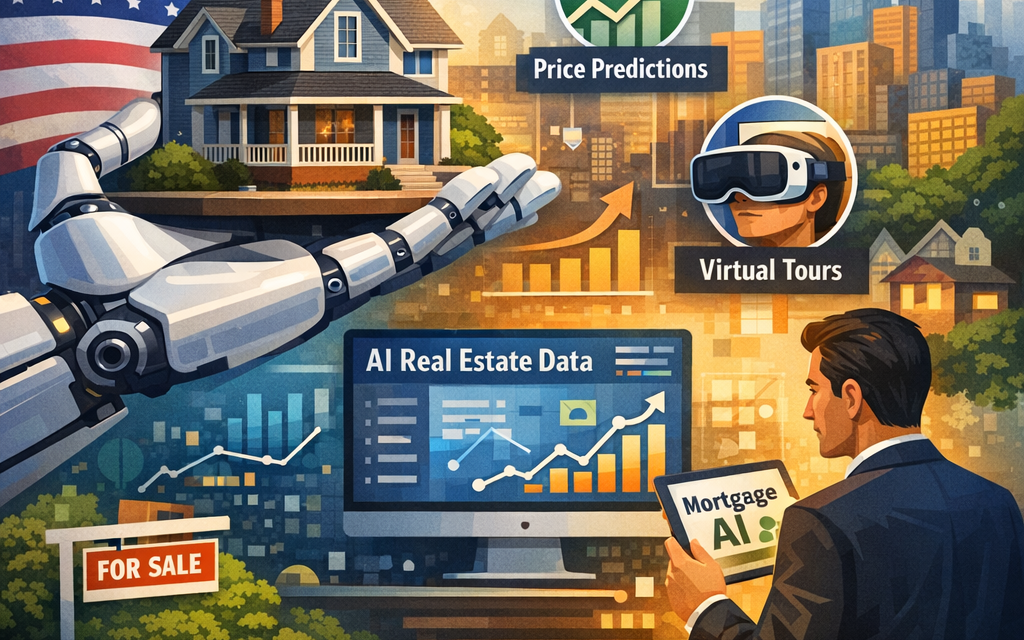

The U.S. real estate market is entering a new era — and it’s powered by Artificial Intelligence. From property searches to price predictions, AI is reshaping how Americans buy, sell, and invest in homes. What once required weeks of manual research can now be done in minutes using intelligent platforms.
In this research-based article, we’ll explore how AI is transforming real estate in the United States, what the data says, and what buyers, sellers, and investors should expect in 2026 and beyond.
1️⃣ AI Is Changing How Americans Search for Homes
- Platforms like Zillow, Redfin, and Realtor.com are now integrating AI tools that:
- Provide personalized property recommendations
- Predict home value changes
- Analyze neighborhood trends
- Suggest optimal listing prices
AI algorithms study user behavior, local pricing history, and housing demand patterns to match buyers with properties that align with their budget and preferences.
📊 Trend Insight: More than 70% of homebuyers in the U.S. begin their property search online, and AI-driven filtering is significantly reducing search time.
2️⃣ Predictive Pricing & Market Forecasting
- Traditional Comparative Market Analysis (CMA) is evolving. AI models now analyze:
- Historical sales data
- Mortgage rate trends
- Employment growth
- Migration patterns
- Local development projects
This enables predictive pricing models that estimate whether a property’s value will rise or decline within the next 6–12 months.
For investors, this means:
- Smarter acquisition decisions
- Lower risk exposure
- Data-backed ROI forecasting
States like Texas, Florida, and Arizona — known for population growth — are seeing AI-driven investor activity surge.
3️⃣ Virtual Tours & AI-Generated Property Staging
- The pandemic accelerated virtual buying behavior, and that shift hasn’t reversed.
- Today, AI-powered tools can:
- Generate virtual staging for empty homes
- Create 3D walkthroughs
- Simulate renovations
- Improve listing photos automaticallyThis increases online engagement and reduces time-on-market.
📈 Research indicates that listings with virtual tours receive significantly higher engagement than those without.
4️⃣ AI Mortgage & Financing Assistants
- Mortgage tech companies are using AI to:
- Pre-qualify buyers instantly
- Analyze credit risk
- Offer personalized loan options
- Detect fraud
This reduces approval timelines from weeks to days — sometimes hours.
For first-time buyers, this is a game-changer.
5️⃣ AI for Real Estate Investors
- Institutional investors and tech-driven firms are leveraging AI for:
- Rental yield prediction
- Market timing strategies
- Portfolio diversification modeling
- Short-term rental demand forecasting
Cities with strong rental growth and tech expansion are becoming hotbeds for AI-based investment analysis.
6️⃣ Risks & Ethical Concerns
- While AI offers efficiency, experts warn about:
- Algorithmic bias in pricing
- Data privacy concerns
- Over-reliance on automated valuations
- Market volatility amplification
Human expertise remains critical. AI should assist — not replace — professional judgment.
What This Means for Buyers & Sellers in 2026
Buyers
- Expect hyper-personalized property recommendations
- Faster mortgage approvals
- Data-driven price negotiations
Sellers
- More accurate pricing strategies
- Smarter marketing tools
- Reduced time on market
Agents
- Shift toward advisory roles
- Increased reliance on analytics tools
- Greater competition from tech-enabled platforms
Final Thoughts
Artificial Intelligence is no longer a futuristic concept in U.S. real estate — it’s a present-day competitive advantage.
The buyers who leverage AI tools will make more informed decisions. The sellers who embrace AI marketing will close faster. And the investors who use predictive analytics will outperform traditional strategies.
The American housing market is becoming smarter — and those who adapt will lead the next wave of growth.